
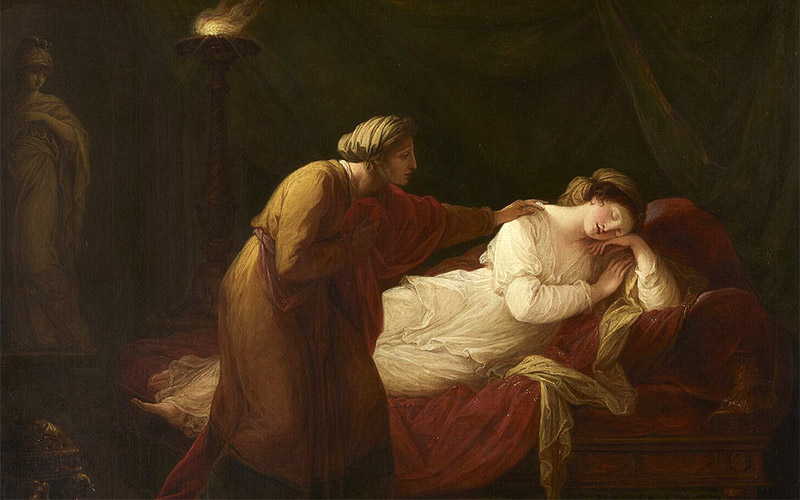
The Homecoming of Penelope
by Amy A. Kass
There is a moment, in Book xxiii of The Odyssey,[1] toward which much of the narrative seemingly tends. It is the moment when Penelope finally recognizes and fully accepts the clear proofs that Odysseus is Odysseus. She runs to him, throws her arms around his neck, and together they submit to the passion for weeping (Od. xxiii.205-208, 231-232). Here a kind of miracle is achieved: this man and woman, husband and wife, separated for twenty years, are reunited on the threshold of old age. Their tears bespeak things sad yet joyful, melancholy yet hopeful: the grief they have suffered, the sorrows they have endured, but also the joy they must feel, knowing that the promises of their youth can somehow be rewoven into their lives now. Even we, the readers or hearers of the poem, who have with Penelope waited and made trial of Odysseus, we too now rest, relieved and assured that Odysseus is home safe.
In describing this climactic moment, Homer uses a surprising simile. He compares Penelope’s running to embrace Odysseus to the landing of swimming, shipwrecked men setting foot on shore having barely escaped their doom:
As when the land appears welcome to men who are swimming,/ after Poseidon has smashed their strong built ship on the open/ water, pounding it with the weight of the wind and the heavy/ seas, and only a few escape the gray water landward/ by swimming, with a thick scurf of salt coated upon them,/ and gladly they set foot on the shore, escaping the evil;/ so welcome was her husband to her as she looked upon him,/ and she could not let him go from the embrace of her white arms. (Od. xxiii.233-240)
Homer’s image vividly reminds us of Odysseus’s long journey home: his many, dreadful encounters with monsters of the deep; his bitterness and terrible aloneness; his relief and amazement to find himself, finally, in Ithaka. But the image refers not to Odysseus but to Penelope. We are asked to imagine her as a shipwrecked one come home. We are taken by surprise, for Penelope has always been at home.
Invariably stationed beside a column, Penelope seemed almost to be a part of the structure of the house. Holding scores of raucous suitors at bay for more than three years, she seemed more a master than a victim. Openly sorrowing for Odysseus, she seemed ever faithful to her household and to her love for her husband. Prudently deliberating, she seemed steady and cautious, never disoriented or cut off.
But Homer’s image suggests another story. By providing us access to the inner life of Penelope these many years, it gives voice to things otherwise silent and hidden. By explicitly inviting us to compare the fate of Penelope with that of the wandering Odysseus, it subtly suggests that though Penelope never left Ithaka, she too was somehow at sea; she too had been shipwrecked—remote and suspended, severed from the relations and deeds that make a house a home. True, Odysseus’s return is crucial for the restoration of the household. True, Odysseus’s successful homecoming is the telos of the epic. True, too, more than anything Odysseus longs for homophrosyne—agreement and harmony with his likeminded wife.[2] But despite the crucial ministrations of gods and men, despite their well laid plans, and despite Odysseus’s own renowned wit and resourcefulness, whether or not he succeeds ultimately depends on Penelope—her inner return, her homecoming. How does this come about? What does it take? As Homer reveals but does not explain the world he creates, by indirection we must find direction out. We begin, then, by collecting and reflecting on what he shows and tells us about women, in general, and about their unique work—weaving—in particular.
I. Women
In the world of which Homer sings, polarity is an important organizing principle.[3] Basic dualities of the natural and human worlds inform everything that happens. If one were to ask Homer, for example, what he meant by human nature, he would offer us two “catalogues”—one male, one female. For him, the differences between men and women so override their sameness as human beings that to be an individual is to be either a man (anêr) or a woman (gynê), never a human being (anthrôpos) as such. Let us collect some of the differences.
In The Iliad, Homer sings about heroes, manly-men, whose pride is in their manliness or martial virtue: their courage, strength, and swiftness. Both the Achaian and the Trojan heroes insist on being men as opposed to women. So Menelaos, for example, reproaches the Achaians (a.k.a. Danaans) when they remain seated and stricken to silence by Hektor’s challenge, thus:
Ah me! You brave in words, you women, not men, of Achaia. This will be a defilement upon us, shame upon shame piled, if no one of the Danaans goes out to face Hektor. No, may all of you turn to water and earth, all of you who sit by yourselves with no life in you, utterly dishonoured. (Il. XII.96-100)
Women are garrulous, cowardly, sedentary, spiritless, weak-willed, and fameless.
Men live their lives publicly—on the battlefield, in the assembly, and in the arena; women privately—mostly indoors, at home. Men distinguish themselves by their brilliant and singular deeds; women by the care and regularity, the patience and fidelity, with which they perform their daily labors. Men are polygamous, women monogamous. Women who stray are regarded as weak-willed, that is, as true to their sex; their wayward actions, though lamentable and regrettable, are therefore forgivable not sinful. Men differentiate themselves by their ancestral virtue, each differing from the next by virtue of his remarkable ancestors. Women differentiate themselves by their marriages—indeed, women abandon their linkages to their own lineages, their marriage ties utterly replacing their ancestral ties—and each woman differs from the next by the bride-price she brings her parents. Men are spurred by echoes from the distant past and hopes for the even more distant future; women, by the call of the immediate present. Women are far more concrete, seldom escaping from the dailiness of life, ever sensitive to the liveliness of today, always concerned about things here and now. In terms of brilliance, women seem altogether pale by comparison with men. Yet Homer’s women are never nonentities.
Though The Iliad is a song about heroes, both the Achaians and the Trojans fight for the sake of Helen; Agamemnon and Achilles, for the sake of Briseis. The plot of The Iliad unfolds the sense in which Helen, and perhaps Briseis too, is more than a mere pretext: the abduction of Helen unleashed the war, and the love of Helen and what she represents somehow animates the warriors almost to the end. Though The Odyssey is the story of Odysseus, the polytropos anêr, the man of many ways, throughout the poem it is women who direct, counsel, and protect this endlessly resourceful man. Moreover, home, woman’s domain, is not only not disdained; it is the telos of the narrated action and perhaps even of Homer’s tale.
As for the importance of women, take, for example, Nausikaa, the young princess of Phaiakia, who is just on the cusp of womanhood: Nausikaa’s courage and good sense, her gentleness and just plain loveliness, revive and restore Odysseus’s humanity, as he tells her himself just before he leaves, “You have given me [back] my life” (Od. viii.468).[4] Or, take Antikleia, Odysseus’s mother, whose unexpected ghostly presence and speech, during his journey to Hades, makes Odysseus starkly confront his own mortality and drives home for him the price of his long absence. Or Eurykleia, the loyal and trustworthy housekeeper in Ithaka, whose efficient keeping of accounts safeguards the family wealth. Or the many goddesses, from Athene, who masterminds Odysseus’s homecoming, to Ino, who, taking pity on Odysseus as he suffered on the open sea, gave him her veil, to the enchanting Calypso, or Circe, or any of the other mysterious females.
As for the primacy and significance of home, Odysseus’s brief adventure with the Lotus-eaters speaks volumes. The Lotus-eaters gave Odysseus’s men lotus, the food of oblivion, making them forget who they were, where they had been, and where they were headed. In his succinct description of the adventure, Odysseus says twice that the lotus made his men “forget the way home.” To forget who you are and to forget home are one and the same. One’s human survival and, even more, one’s very identity, depend upon memory, principally, it appears, memory of home. One’s relations to home make one who and what one is. The Odyssey abounds in further illustrations of this.
Though women are neither his avowed subject, nor his main concern, Homer’s women are neither simply servile nor merely perfunctory. Though they are not obviously central in Homer’s world, they appear to be central to Homer’s thought. Indeed, one noted commentator, Samuel Butler, especially impressed by Homer’s portraits of women and the importance he attaches to domestic life in The Odyssey, argued that the poem could only have been written by a woman.[5] But however much we may argue about Homer’s own gender, there is little doubt that Homer’s women—like Homer himself—weave a subtle and not altogether invisible web through the action of both epic poems, ultimately controlling and ensnaring the whole.
If Homer’s women are indispensable for understanding Homer’s thought, weaving is indispensable for understanding womanliness. Weaving is the only specifically female activity in both epics, and both women and goddesses weave. Weaving, both actually and symbolically, integrates and holds together the various strands and aspects of womanhood, and thereby also of home. So Hektor commands Andromache, “Go . . . back to our house, and take up your own work, the loom and the distaff . . . the men must see to the fighting” (Il. VI.490-492). Women’s work is in the home, at the loom. If one’s work reveals what one is essentially, then one suspects that it is in relation to weaving that a woman would show herself most fully. What then, according to Homer, is weaving?
II. Weaving
Homer alludes to many activities and instruments closely connected to weaving—shepherding, shearing and carding wool, collecting and refining dyes, to mention but a few. We concentrate here on two: spinning, an activity separable from but preparatory to weaving, and weaving proper. Let us first consider spinning.
In spinning, a bundle of unworked carded wool is held on a distaff from which it is drawn into a long and continuous, largely homogeneous, single thread, by means of a spindle. To spin (in Greek klôthein, the root of our words “cloth” and “to clothe”) requires patience and dexterity: one must carefully and laboriously draw out and carry through a strand, which is necessarily always delicate and weak.
Homer connects the activity of spinning with the work of the Spinners (klôthes) or Fates (Moirai), those dreaded women who spin the threads of human beings, allotting their portions or destinies (Od. vii.197). When one is born, the Spinners spin out the thread or destiny of one’s future life, which means, in the first instance, that they determine its length. They fix the time of one’s death: one’s “day of Fate” is, in Homer, the day of one’s death. The Fates are restrictive; they enjoin a limit. Even the Olympian Deities, though themselves immortal and ageless, have their powers strictly limited by the Fates. What the Fates prescribe for human beings, not even Zeus can alter. As Athene tells Telemachos: “Not even the gods can fend it away from a man they love, when once the destructive doom of leveling death has fastened upon him” (Od. iii.236-238).[6]
The spinning of woolen threads is thus like the merely natural activity of generation; the spun thread, an image of a naked, undifferentiated life in all its precariousness. While both convey the unavoidable fragility and vulnerability of embodied life simply, the solitary thread suggests the special weakness of a life lived cut off and isolated from others. By drawing together spinning and fate, Homer seems to suggest that a woman who spins is somehow akin to the goddesses of natural necessity.
But if spinning reminds one of the dark realm of necessity, weaving brings one to life and civilization. Weaving, in Homer, takes us to the realm of the Olympians. Here not the Fates but Athene holds sway.[7]
In weaving, a wooden loom or frame is erected, and the warp, consisting of vertical threads, is stretched and immobilized upon it. A shuttle containing thread (the woof or the weft) is slid horizontally from side to side, backward and forward, between the warp threads to form the web. To weave is to interlace threads in a steady and orderly way, integrating separate strands into an articulated whole without doing violence to any. Thus, weaving, unlike stitching, creates form without violating matter. Yet the woven whole does transform its parts. For by being brought into union with other threads, each strand is made stronger and less vulnerable, loose ends are tied in and protected. And the web, a careful and sturdy, yet delicate and intricate balance of many separate threads, assumes a character and texture of its own. By thus transforming the parts, the web not only preserves them but endows each a meaningful place in a patterned whole. Sometimes, the pattern becomes very elaborate and even articulate, as when variations of ordered sequences are used to weave a picture or even a story into the web.
A woven web is thus a coming together of art and nature, or, one might even say, of humanity and the cosmic order. For, ultimately, one weaves one’s web out of the sun, which nourishes the grass, which nourishes the sheep, who grow the wool, which is spun into thread, which is preserved when it is patterned on a loom in weaving. Weaving is the very model of bringing nature under the artful use of intelligence and rational order.
No wonder Athene dowers weavers. For clear-sighted, bright-eyed Athene, the daughter of Zeus who most clearly resembles her father in intelligence and counsel, who kindles the courage of warriors but disdains their fury and rashness, inspirits us to meet necessity in a sensible or prudent way. She plots and contrives with an eye to the future, yet never loses sight of what is concretely before her, here and now. Her ardent support of artfulness is matched by her deep concern for lawful arrangements, both evident in her patronage of weavers. For weaving is the orderly application of artful intelligence, guided by set rules and customs, which brings together disparate natural materials, forming them into harmonious union, in the service of protection and perpetuation. Indeed, weaving is a wonderful image of homemaking and marriage, those paradigmatic human activities that preserve and perpetuate; and the woven web is a wonderful image of family.
In family—also a domain of Athene—otherwise solitary and fragile individuals take their place, find connections, gain support. Though each life, like each spun fiber, still has a beginning and an end, these ends are bound into a larger whole and related also to those that come before and after. The weaver, like the homemaker—or the statesman, also frequently compared to the weaver—is the unifier, the harmonizer, the ruler. She articulates the order which not only protects our vulnerable natures in the face of grim necessity, but which, given voice in shared speeches and conventions, humanizes and gives meaning to this particular web of interconnected lives.
Weaving is not only a metaphor for the ordering of a family. Most literally and concretely, weaving creates and adorns a household. The woman who weaves provides for its prosperity and perpetuation. For Homer, the loom, along with the hearth and bed, stands at the very center of a home. No loom, no home.
Women weave coverings, coverings for the body, the bed, the floor, the table, the wall, the grave—robes, blankets, rugs, cloths, tapestries, and shrouds. These coverings not only protect the objects they cover; they also contribute to the wealth and substance of the household. The treasured tapestries and shining robes are passed from generation to generation; as we still say, we treasure our heirlooms. Some of the woven wealth begets more wealth: women weave sails that outfit ships that carry men abroad to increase their substance even further. Woven goods, used as guest gifts, also increase the influence of a household, through the ties they form with other households. The Phaiakians, who live in the greatest luxury, are the best weavers, the best sailors, and the best hosts—and, we note for later, also the best appreciators of stories.
But weavings not only protect us in the present or pile up wealth for the future. They help us to mark and render meaningful the passage of time. The daily and regular work of weaving punctuates, as it flows along with, the regular stream of days. Seasons too are marked with the loom, by weaving different wear for winter and summer. But most important, weaving marks humanly significant times of life—the time of birth, the time of marriage, the time of death; it clothes the newborn, veils the bride, and enshrouds the departed. As weaving introduces patterns that cover over the homogeneity of unwoven thread, so woven garments commemorate and render visible the human patterns that cover over the otherwise undifferentiated and silent passage of the time of our lives. And for the weaver herself, as weaving is her work, so her weavings reveal much of the story of her life.
Thus we see why weaving is frequently a metaphor also for songs and story. The Homeric word for story, oímê, originally conveyed the imagery of weaving.[8] Through telling their stories, human beings try to hold together and give meaning to the various threads and times of their lives. Poets, inspired by that other daughter of Zeus, the Muse, are super-weavers; they bring together the story-threads of many lives to present a tapestry—in the grandest case, presenting the cosmic whole, showing us the relations not only of one life or household with another, but also of human beings to the immortal gods, above and below.
Remembering the gods reminds us that weaving, like other human arts in Homer, is not without its limits. On the one hand, though it confronts Fate, weaving cannot defeat it; it can anticipate change and decay, but it cannot thereby guarantee permanence. On the other hand, though dowered by Athene and the Olympians, weaving—human art generally—cannot make men godlike or independent. The arts tempt us to self-sufficiency, to rely only on our own cleverness; but weaving rightly understood requires remembering the gods and, more generally, our dependence on things not of our own making. The goddess dowers weavers not because she likes them but because they need her. Good weavers acknowledge both these limits: the superior power of Fate or necessity, the superior wisdom of the divine. Expert weavers have knowledge akin to the Fates and a dowry from Athene. This does not enable them to predict the future or avoid suffering. It does give them some understanding of how things stand between human life and the divine, and hence of what may be realistically possible within human experience.
Homer’s weavers neither deny nor ignore human futility. Nor do they meet necessity, as the heroic warriors do, by going forth to beat it down. Weaving, a species of wealth-getting, symbolic of marriage and procreation, in the service of home, meets necessity by working harmoniously with the rhythms of nature. To weave is to live in time, to be aware of one’s relations in the present, as well as to the past and the future. Thus, by working in accordance with the permanently changing whole, weavers knit permanence into their own lives. Weavers seem, then, to embody the best possible relation between nature and human art. Womanly excellence points us to the best human possibility.[9]
III. The Wanderings of Penelope
If weaving points to the right order of things, weaving gone astray signifies disorder. Homer shows us two conspicuous examples: Helen’s weaving in The Iliad—weaving which is self-glorifying—and Penelope’s weaving in The Odyssey—weaving which becomes self-denying. Both embody aspirations to timelessness: Helen’s, the desire to live forever, to have undying fame; Penelope’s, the desire to hold on to the past, to freeze the moment and make time stand still. Both are signs of sterility and fruitlessness. We can see the problem with Penelope’s weaving more clearly by looking more closely at Helen’s.
Everything about Helen reminds us of war. Even in The Odyssey, when she is back safely at home with Menelaos, the war remains prominent in her life: We first come upon her celebrating the marriage of her only child to the son of Achilles; she does not weave but she sits beside her silver-wheeled wool basket, an object paralleled only by the wheeled tripods in The Iliad (Il. XVIII.375); she tells her guests stories about the war.
When we first meet Helen in The Iliad, she is in her chamber “weaving a great web, a red, folding robe, and working into it the numerous struggles/ of Trojans, breakers of horses, and bronze armoured Achaians,/ struggles that they endured for her sake at the hands of the war god” (Il. III.125-128). Helen, who is always associated with “shimmering garments” or “luminously spun” robes, is here weaving such a gown, but one which must always remain imperfect. For the story she is weaving into it can know no end.[10]
Helen is, in effect, weaving into the robe the story that Homer follows; its pattern is heroic ambition, a pattern which she herself provokes. For Helen of Argos, divine among women, daughter of Zeus, beautiful and terrible Helen, both reflects and embodies the end of heroic ambition: to be forever young and beautiful, to be immortal and ageless, to be honored as the gods are honored (Il. VIII.538-540). To lift Helen’s veil is to behold someone who is always young and beautiful, yet forever unattainable, beyond the reach of all men.[11] Though the warriors, in the course of The Iliad, become liberated from the immediate purpose of the war—the recovery of Helen and her possessions for Menelaos—they are never liberated from the desire to be united with Helen, that is, to become one with immortal and ageless beauty. The love of fame and glory is, in essence, no different from the love of Helen.
Though Helen is often within a house, she is never of the home. She belongs neither to the home of Menelaos nor to the home of Paris. Her ability to imitate the voices of the wives of each of the Argives suggests her inability to be fully the wife of any one man. Similarly, her weaving, which records and anticipates struggles men endure and will continue to endure for her sake, points to her abiding remoteness and elusiveness. Helen’s beauty isolates her, elevates her, and finally transmutes her into an object; unwittingly, she even objectifies herself in her weaving. Not coincidentally, Helen is no longer fertile: she and Paris have no issue, and when she returns to Menelaos, “the gods gave no more children to Helen” (iv.12).
Helen’s weaving, like Helen herself, can belong to no one, not now not later. But like Homer’s poem, it illuminates, as it commemorates, the futility of heroic ambition and the terrible human costs it exacts. Also like The Iliad itself, Helen’s weaving makes clear the meaning of her prophetic remark, that Zeus set upon herself and Paris an evil fate so that they “shall be made into things of song for the men of the future” (Il. VI.358). In short, Helen’s unfinishable weaving shows us why men forever seek glory, and why its pursuit is forever a snare and a delusion.
Unlike Helen, very little about Penelope reminds us of the war. Penelope, whose name means “spinner” or “spinster,” reminds us always of home. Praised for her steadiness, loyalty, self-restraint, discretion, and carefulness, and prized for her intelligence and beautiful handiwork, Penelope is always at home. Whether stationed at her loom, or in her upper chamber, or beside a stout column in the strongly built palace of Odysseus, she seems the very incarnation of the idea of home and Homer’s ideal of womanhood. To lift Penelope’s veil is to behold a living woman with hopes and joys and sorrows, someone essentially strong and enduring, prudent and thoughtful.
Penelope’s endurance and cleverness are combined in her plot of weaving and unweaving. She strives, with the aid of her weaving, to save her home. Yet the clever device, notwithstanding—or perhaps because of—its success, contributes to the problems of her home. Perhaps worst of all, unbeknownst to herself, it even carries her away in spirit from hearth and home. Penelope’s weavings are Penelope’s wanderings.
The Odyssey begins at the end of things. It has been twenty years since Odysseus left Ithaka. For the last three, almost four of those years, Penelope has been besieged by suitors—more than a hundred haughty, arrogant, rapacious, overbearing, shameless young men who delight in games and gluttony. They while away the hours, as they eat away the substance of Odysseus. With their minds forever on pleasure, they are indifferent to the gods, ignoring both omens and strangers. They listen to sad songs—even the latest song of the sad return of the Danaans—but regard them only as pleasing distractions to fill the hours between eating and bedding down. These mindless and shallow pleasure-seekers remind us both of the Lotus Eaters, for their pursuit of pleasure, and of the Cyclops, for their depthless vision, cannibalistic appetites, and singular indifference to the gods. Not only have they forgotten the gods; they seem even to have forgotten why they are where they are. Their siege is the completion of the decay in Ithaka that began when Odysseus left for Troy; the rot within Odysseus’s home mirrors the corruption outside.
Antinoos, whose name means “hostile-minded,” and Eurymachos or “wide-fighter,” are the leaders of the pack, the sons, respectively, of Eupeithes or “compliant,” and Polybos or “many oxen.” Their very names, then, reveal the state of Ithaka: the elders, compliant and ignorant, have become indifferent, and have withdrawn all claims to authority. The suitors go unchecked within the house of Odysseus because they have already subdued their parents, perhaps by the same contrariness and combativeness. There has been no assembly, no public governance in Ithaka, for twenty years. But perhaps nothing depicts the decadence of Ithaka as clearly as the sight immediately in front of the palace: a dunghill on top of which sits Odysseus’s once splendid dog Argos, now riddled with dog ticks, neglected and forgotten (Od. xvii.290-323). Like Argos, Ithaka is lacking both strength and substance. Ithaka has been abandoned.
Threatened from without and from within, Penelope strove to make good Odysseus’s charge to her: to care for Laertes and Antikleia, Odysseus’s father and mother, inside the palace; to rear and educate their son Telemachos (Od. xviii.260-270); and to keep the home intact and rule it until he came of age. Ever concerned that someone would come and deceive her, she actively sought to hold herself steady. The clever ruse she fashioned to deal with the suitors made manifest her effort of many years.
Penelope set up a great loom and for three years wove and unwove, undoing at night what she wove during the daytime. Allegedly weaving a shroud for her father-in-law Laertes, her loom ran empty day after day. Penelope wove emptiness to combat disorder, vacancy to guard against disorientation. Endlessly raveling and unraveling, weaving and unweaving, her efforts were productive of nothing.[12] Her weaving parodied weaving, or rather, it was more like an image of spinning. Threads were stretched out and twisted, only to be untwisted and rewound. Her threads, like her life, remained unconnected. By endlessly going round and round, covering and uncovering the same ground, she allowed her threads—like her life—to remain unmeasured, indeterminate, unfinished. In this activity, Penelope lived out her name: “Penelope, weaver” became “Penelope, spinner”; “Penelope, wife” became “Penelope, spinster.”
Penelope’s attitude toward the suitors mirrors her indeterminate weaving and unweaving. She holds them at bay, neither refusing nor accepting their proposals of marriage (Od. i.249-250). She keeps her distance but sends them flattering messages (Od. ii.90; xiii.379-381). She vacillates between active concern and passive withdrawal. She cries at night, but looks radiant by day. She tries to keep them away by holding them near, and her efforts to do so completely consume her attention and energies. Penelope’s threads fail to ensnare her suitors, but they almost ensnare her. The emptiness she wove to deal with the emptiness she must have felt became habitual. Her attempts to leave room for Odysseus almost replaced him. Her efforts to preserve her home attenuated her attachments to it.
Penelope’s weaving and unweaving, her courting and uncourting, her habitual grieving and despair, show Penelope to be out of touch with time. In her desperate attempt to hold fast to what was, she ceases to live in a present that looks to the future, and thus acquires a false relation even to the past. She is suspended in time and place and becomes frozen within. Neither cutting nor weaving her threads, Penelope suspends herself from a single strand that becomes ever more fragile. She loses sight of the web of relations that make a house a home. She has forgotten Laertes and neglected her son Telemachos. She has become inhospitable to strangers, and, hence, estranged too from the gods. Her home is in shambles. The charge Odysseus gave her when he left for Troy seems to have been all but forgotten.
It should go without saying that none of this does Penelope intend. She is not guilty of willful wrong-doing; she faces terrible circumstances and seems rather to be pitied than blamed. Nevertheless, we the readers are able to see the meaning of her attempts to beat back grief by making time stand still and coping with despair by means of cleverness.
Though The Odyssey begins with the council of Zeus that plots Odysseus’s homecoming, Odysseus cannot return home unless Penelope does also. One cannot have a homecoming if there is no home. Though our attention is drawn to Odysseus’s journey, reweaving the many relations that comprise his home is, in fact, the deeper burden of much of the narrative. And this depends, most fundamentally, on Penelope.
If she is to restore life to her home, Penelope must again begin to weave. She must bring herself back into time. She must bring herself back into relation with her family and her gods. Only then will she be prepared to accept Odysseus, and only then will his return succeed.
IV. The Homecoming of Penelope
As the poem begins, Zeus, taking advantage of the absence of Poseidon (Odysseus’s nemesis), calls a council and begins to reorder the affairs of men. The time is right for Athene to make her appeal on behalf of Odysseus. In Ithaka, Penelope’s ruse has been discovered, compelling her to finish the shroud. But what happens next depends on whether she is able, too, to re-weave her unraveled life. Perhaps this is why it takes two councils of the gods to arrange the homecoming of Odysseus.
Of the various things that propel Penelope’s return, three appear to be decisive: the awakening and departure of Telemachos; the stories Penelope hears and tells as she sits beside the fire conversing with the “stranger,” whom we know to be Odysseus disguised as a beggar; and finally, the test of the bed. Following Homer’s lead, we start where his epic does, looking in on Telemachos.
As we open the door to Odysseus’s house, we find Telemachos, seated among the feasting and gaming suitors, in the smoke-filled halls, grieving and daydreaming. Though aware of their malevolence, he knows not what he could or should do or even whether he could or should do anything. He consoles himself by imagining the great father he has never seen, coming back, scattering the suitors, and setting things right. Athene’s sudden visit and timely questions—“Are you, big as you are, the very child of Odysseus?” “What feast is this, what gathering? How does it concern you?” (Od. i.207, 225, emphasis added)—immediately cause Telemachos to reposition himself, literally, by getting up and moving, and more important, psychically, by revealing and, hence, acknowledging, to the total “stranger,”[13] his own impotence, rage, and shame. With such seeds planted, Athene tactfully urges Telemachos to “consider some means by which [he] can force the suitors out” (Od. i.269-270), but then pointedly tells him what he must do, drops her disguise, and flies off.
Thus emboldened and inspirited, Telemachos straightway begins to act. Like many a young man, then and now, his first impulse—his own “considered means”—is to berate his mother and to warn her to go back to her loom and distaff.[14] Penelope retreats in “amazement,” and, we imagine, Telemachos does too, even as he carefully calculates his next steps.
As instructed, the next morning Telemachos convenes the assembly, the first assembly held in Ithaka in twenty years. With the leader’s scepter in hand, he publicly denounces the suitors for besetting his mother “against her will,” warns them that things hitherto endured will “no longer” be so, and threatens to sue them for recompense. But in the midst of his speech, suddenly overwhelmed by his own bravado, Telemachos bursts into tears, and dashes the scepter to the ground. Unwittingly, Antinoos now picks up where Athene left off. “You have no cause to blame the Achaian suitors,” he sharply asserts,
. . . it is your own dear mother and she is greatly resourceful./ And now it is the third year, and will be the fourth year presently,/ since she has been denying the Achaians./ For she holds out hope to all, and makes promises to each man,/ sending us messages, but her mind has other intentions./ And here is another stratagem of her heart’s devising./ She set up a great loom in her palace, and set to weaving/ . . . a shroud, for the hero Laertes, . . . /Thereafter in the daytime she would weave at her great loom,/ but in the night she would have torches set by, and undo it./ . . . but when the fourth year came . . . we found her in the act of undoing her glorious weaving./ So, against her will and by force, she had to finish it. (Od. ii.87-110)
Thanks to Antinoos’s direct attack on his mother, Telemachos’s anger is fueled, his resolve renewed. Now, concern for his own miserable plight, as well as his mother’s, spurs him on. And the journey he was earlier directed to take assumes greater urgency, for him and, in turn, for Penelope. Telemachos’s travels will launch him into adulthood and make vivid the criminal intentions of the suitors, but they will also force Penelope, once again weaving, to awaken and dislodge herself from her routinized and habitual attitude of grief. We note more carefully Penelope’s reaction.
Telemachos’s departure was initially undetected by his mother. Penelope neither noticed he was missing nor heard any report of his journey for several days. Clearly, her earlier amazement at her son’s sudden assertiveness did not suffice to overcome her own self-absorption. She is now most brutally tested. Penelope hears of Telemachos’s departure only after the suitors do. Thus she simultaneously learns not only that he has left, but that the suitors are plotting to kill him. She collapses in utter despair; clouds of sorrow descend upon her; she falls to the floor and weeps pitifully; she refuses all food and drink. Homer compares Penelope, in her despair, to a besieged lion, who “caught in a crowd of men turns about/ in fear, when they have made a treacherous circle about him” (Od. iv.787-794). She seems instinctively to understand that the plot against the life of her son is an attack on her own life. At last, she sees that the fate of Telemachos cannot be separated from her own.
Penelope’s fear and concern for Telemachos abruptly draw her back to the present and turn her attention to the future. Pondering what to do next, she not only thinks of Laertes but also recalls and prays to the gods (Od. iv.735). She has a dream in which she contrasts the fame of her husband with the innocence of her son, the grief she has had for her husband with the even greater grief she now has for her son. Though just the beginning of her return, the poet underscores its importance. The narrative abruptly shifts to Ogygia, an island in the midst of nowhere, where Odysseus has been hidden away for seven years. Which is to say, having started the homecoming of Penelope, and hence the reconstruction of his home, Athene, Odysseus’s Olympian advocate throughout, can turn her prime attention back to her man.
Penelope is never again indifferent to her fate. Recognizing the urgency of her need, she now plots and calculates her every move, even before she settles on a complete strategy. She shows herself to her suitors. She publicly rebukes them, confronting them with their own criminal behavior (Od. xvi.431). She prays for the death of the suitors (Od. xxvii.494). She listens attentively to the stories announcing Odysseus’ return (Od. xvii.150-161; 512-527). Indeed, she seems to turn the very homecoming of Telemachos into an inquisition about Odysseus. And from the moment the Odysseus, disguised as a beggar, enters her halls, her attention is riveted upon him. We are brought to the threshold of Book xix, and the second stage in Penelope’s homecoming.
It is evening. The halls of the palace have been emptied of the suitors and miraculously illuminated by a god-made light. Eager to question the beggar, Penelope orders her servant to set up a chair. Penelope and Odysseus sit beside the fireside, alone together for the first time in twenty years. As they begin to speak, each is guided by his own concern: Odysseus must discover whether Penelope can and will accept him back; Penelope must find a way out of her predicament, to preserve her own and her son’s future. Both purposes depend, as Odysseus seems quickly to perceive, on Penelope’s self-understanding. Though she has recovered the will to act, she still lacks self-knowledge. Her plans for the future require that she reweave her past into her present. To know what she can or should do, she must first recall who she was and understand what she has become. Indeed, recovering herself through re-integration of her past seems to be the main burden of Book xix, the central and decisive episode in the homecoming of Penelope. It is accomplished by the artful weaving of stories.
Penelope is the first to speak. She asks the stranger: “What man are you and whence? Where is your city? Your parents?” Odysseus responds with the utmost craft and cunning:
“Lady, no mortal man on the endless earth could have cause/ to find fault with you; your fame goes up into the wide heaven,/ as of some king who, as a blameless man and god-fearing,/ and ruling as lord over many powerful people,/ upholds the way of good government, and the black earth yields him/ barley and wheat, his trees are heavy with fruit, his sheepflocks/ continue to bear young, the sea gives him fish, because of/ his good leadership, and his people prosper under him./ Question me now here in your house about all other/ matters, but do not ask who I am, the name of my country,/ for fear you may increase in my heart its burden of sorrow/ as I think back; I am very fully of grief (polystonos), and I should not/ sit in the house of somebody else with my lamentation/ and wailing. It is not good to go on mourning forever.” (Od. xix.106-120)
Mindful of the delicate task before him, Odysseus attempts to bring Penelope back into the past. Before identifying the man he has become, he tries to bring the young Odysseus to mind. Hence, he describes Penelope now as if she were Odysseus then, comparing her to a good king—faultless, famous, blameless, god-fearing, and powerful—whose kingdom is fruitful, and whose people prosper. He describes himself beguilingly as polystonos (a man very full of grief), an especially apt epithet for Penelope. And, in the guise of explaining his reluctance to answer her questions, he offers Penelope advice: “It is not good to go on mourning forever.” By so attempting to turn her attention away from the stranger before her, he invites Penelope to see how things stand with herself. In effect, he returns her question: “Who are you?” Penelope takes the bait:
“Stranger, all of my excellence, my beauty and figure,/ were ruined by the immortals at that time when the Argives took ship/ for Ilion, and with them went my husband, Odysseus./ If he were to come back to me and take care of my life, then/ my reputation would be more great and splendid. As it is/ now, I grieve: such evils the god has let loose upon me./ For all the greatest men who have power in the islands,/ . . . and all who in rocky Ithaka are holders of lordships,/ all these are my suitors against my will, and they wear my house out./ Therefore, I pay no attention to strangers, nor to suppliants,/ nor yet to heralds, who are in the public service, but always/ I waste away at the inward heart, longing for Odysseus.” (Od. xix.124-136)
Instead of the manly excellence, fame, and widespread power of which Odysseus had spoken, Penelope speaks of her ruined beauty and figure, her neediness and insufficiency. Instead of the good order and flourishing of Ithaka, she notes her own enslavement and the wearing away of her house. And, notwithstanding her evident interest in the stranger before her, she recognizes, too, her long neglect of strangers, suppliants, and public servants—in effect, her neglect of the gods.
Without further prompting, Penelope is now moved to tell her own story, the story of her web, from the moment the idea was put into her head until the moment it was detected and she was forced to finish it—all the more remarkable, as only this once do we learn about the web from the spinner herself. In concluding, she remarks:
“Now I cannot escape from this marriage; I can no longer/ think of another plan; my parents are urgent with me/ to marry; my son is vexed as they eat away our livelihood;/ he sees it all; he is a grown man now, most able/ to care for the house, and it is to him Zeus grants this honor. (Od. xix.157-161)
Penelope’s tale is indeed revelatory to the stranger before her but no doubt to herself as well. For in pulling together the threads of the story that can answer Odysseus’s tacit question—“Who are you?”—Penelope has scrutinized her life, showing its meaning also to herself. She articulated how, despite her good intentions, she neglected everything—her parents, her son, her house, her gods. No wonder she now sees only one alternative before her: to marry and to leave this house.
Once again, Penelope turns to Odysseus and asks, “Who are you?” This time Odysseus responds with care and tact, patience and respect, and with a story. He addresses distraught Penelope as the “respected” and “honored” wife of Odysseus, son of Laertes. He identifies his beggared self as a man of noble birth—“the son of great-hearted Deukalion, the grandson of Minos, a King who conversed with Zeus” (Od. xix.175-180, emphasis added)—gives himself a “glorious name,” and recounts the time, twenty years ago, when he first met Odysseus and entertained him in his house. Odysseus thus artfully provides Penelope an opportunity to begin to overcome her neglect of strangers and her many years of estrangement. For in calling her “respected” wife of Odysseus, he invites her to think of herself as such. By producing noble credentials, he urges her to try to penetrate his ragged appearance. In reporting his own hospitality, he beckons her to reciprocate. Just at this point Homer interjects: “He knew how to say many false things that were like true sayings” (Od. xix.203).
Odysseus’s strategy hits its mark: “As she listened her tears ran and her body was melted,/ as the snow melts along the high places of the mountains/ when the West Wind has piled it there, but the South Wind melts it,/ and as it melts the rivers run full flood” (Od. xix.204-207). The tears here prompted by the story, unlike the tears she had shed so often alone, melt her body and restore her to life. Penelope, like the mountain, frozen within for so very long, begins to melt. In the sequel, her words and deeds reveal the change.
In their subsequent exchanges, Penelope moves ever closer in speech to the stranger, calling Odysseus first “pitiable stranger,” then “stranger and guest,” and then “guest dearer than any others.” She suddenly assesses the stranger to be a contemporary of Odysseus’s and, for the first time, she offers him (Homericly appropriate) hospitality. She asks Eurykleia, Odysseus’s own trusted nursemaid since birth, to wash “the feet of one who is the same age as your master,” who “must by this time have just such hands and feet” (Od. xix.358-359), but she does not yet penetrate Odysseus’s disguise. At the moment Eurykleia makes her discovery of Odysseus’s scar and precipitously drops his foot into the basin of water, Penelope’s glance is averted, her mind is elsewhere.
After the foot bath, Penelope and Odysseus resume their conversation though it is by now quite late. Though still undecided about what to do, the alternatives Penelope contemplates are now somewhat different. She recalls the story of Pandareos’s daughter, the greenwood nightingale. Grief torn, like the legendary nightingale to whom she now compares herself, who killed her own son when “the madness was on her” (Od. xix.523), Penelope wonders whether to stay beside her son or to marry the best of the Achaians. She no longer insists that she must go away.
Continuing, she asks Odysseus to listen to a dream she had and to interpret it for her. The dream is about numerous geese in her house, whom she “loved to watch” (Od. xix.537). Suddenly, a great eagle swoops down and kills them all. She laments their death, crying out in sorrow as they are slain. But the eagle reappears, revealing himself to be Odysseus. The Odysseus before her readily agrees with the interpretation of the Odysseus in her dream, namely, that the dream portends the impending death of the suitors.
Though Penelope now insists that her dream was merely a vain wish, almost immediately after talking about it, she knows exactly what she will do: she will select her new husband through the contest of the bow. Odysseus applauds her decision. Penelope abruptly ends their conversation, claiming now a need for sleep, the sleep she had moments before claimed never to be hers. What has happened?
What the departure of Telemachos had begun seems now to have been brought to completion. Through telling her story, and with the aid of stories woven into it, Penelope seems now not only to fully understand her own complicit behavior—she “loved to watch” the “geese” in her house—but also to penetrate her self-deception, as well as the disguise of the man before her. Indeed, one might even say that the one caused the other: Penelope’s self-recognition enabled her to recognize Odysseus. Proof: she immediately knows what to do. Consider her plan.
Both the bow and the contest Penelope proposes had belonged to Odysseus. They were his peculiar marks. He carried his bow and only he could string it. It linked him to the generations of the heroes—it originally belong to the hero Iphitos—and the contest, in which it was used and in which he excelled, enabled Odysseus to display his manly excellence. The bow had been stored away for the past twenty years in the “inmost recess” of the house (xxi.8). To retrieve it, and hence, to set up the contest, Penelope is, quite literally, obliged to return to the very center of her home. Thus by reviving this ritual of old, Penelope is in fact re-asserting and declaring her ties to the past, to her husband, and to the house of Odysseus.
That Penelope surely knows what she is doing is affirmed by the fact that she argues for letting the stranger participate in the contest and does not leave until he is given the polished bow. And, though they do not yet recognize the stranger, the suitors too recognize that they are being asked to compete against Odysseus.
As everyone knows, Odysseus strings the bow, wins the contest, and rids the house of the suitors. Penelope will not go to another house; her husband has reclaimed his home. And yet Penelope’s homecoming is not yet complete. Though she has again committed herself to her home and revived her ties to the past, she now must wonder whether these are sufficient to secure the future. As she now too-well knows, time, wanderings, and hardships do strange things to the spirit; she must wonder about what they have done to Odysseus. No question, the stranger with the scar on his foot is none other than Odysseus. No question, in manly display with the bow he is the same Odysseus. But such signs do not reveal the heart. Penelope, perhaps all the more because of the bloody slaughter of the suitors, wonders what twenty years of war and trouble have done to the best of the Achaians. She watches and waits, again holding herself aloof and steady, wondering just who it is, who has come home.
The answer comes in Book xxiii. His patience exhausted by her aloofness, Odysseus complains to Penelope:
“You are so strange. . . ./ No other woman, with spirit as stubborn as yours, would keep back/ as you are doing from her husband who, after much suffering,/ came at last in the twentieth year back to his own country./ Come then, nurse, make me up a bed, so that I can use it/ here; for this woman has a heart of iron within her.” (Od. xxiii.166-172)
Penelope seizes the occasion to find out what she most needs to know, putting Odysseus to the test:
“You are so strange. I am not proud, nor indifferent,/ nor puzzled beyond need, but I know very well what you looked like/ when you went in the ship with the sweeping oars, from Ithaka./ Come then, Eurykleia, and make up a firm bed for him/ outside the well-fashioned chamber: that very bed that he himself/ built. Put the firm bed here outside for him, and cover it/ over with fleeces and blankets, and with shining coverlets.” (Od. xxiii.174-180)
Odysseus is enraged: “What you have said, dear lady, has hurt my heart deeply. What man/ has put my bed in another place” (Od. xxiii.183-184)? And he proceeds to rehearse, in great detail, the construction, the look, the place, the adornment, and character of the bed he had made so long ago.
It is Odysseus’s reaction to her suggestion that their marriage bed, a bed fashioned out of a still-living olive tree rooted in the center of their home, had been cut and moved that finally shows Penelope what she needs to know. It is his memorable burst of anger that is so revelatory. For it shows that, despite his wanderings, Odysseus, like the marriage bed he built for himself and Penelope, still has living and deep roots in the home. Now, at last, Penelope “burst into tears and ran straight to him, throwing her arms around the neck of Odysseus, and kissed his head” (Od. xxiii.207-208). Penelope embraces him, as swimmers embrace the shore after Poseidon has smacked their strong-built ship on the open water. Odysseus’s affirmation of his own rootedness thus completes the homecoming of Penelope.
Postscript
Penelope is home and so is Odysseus, yet Homer detains us a little longer. As Odysseus is reunited with his father, Laertes, and defending his home against the relatives of the suitors, the suitors descend into Hades and deposit there the story of Penelope’s web and Odysseus’s return. As in the two previous accounts of the web—by Antinoos (in Book ii) and Penelope (in Book xix)—the suitors say, “So against her will and by force, she had to finish it,” but they now tell for the first time about the completed web itself: “She displayed the great piece of weaving that she had woven. She had washed it, and it shone like the sun or the moon. At that time an evil spirit, coming from somewhere, brought back Odysseus” (Od. xxiv.146-149).
The completed web, like the well-ordered home whose restoration it both images and makes possible, is the theme—and also the image—of the completed story, now deposited in Hades, the bank of memory and source of stories. Weaving, marriage, and story-telling, but especially stories of weaving, marriage, and story-telling, bring light like the very sun or moon to a world in which all that lives must die. Now, thanks to Homer, even in Hades, the repository of memory, not all is darkness. For stories that remind us of the best brighten our present and illuminate a way into the future.
Notes
[1] All references to The Odyssey and The Iliad are to the following editions: Homer, The Odyssey, Richmond Lattimore, trans. (New York: Harper and Row, 1977); Homer, The Iliad, Richmond Lattimore, trans. (Chicago: University of Chicago Press, 1974). Book and line numbers follow quotes; upper case Roman numerals are used for The Iliad, lower case for The Odyssey.
[2] Odysseus suggests this in the prayer he earlier bestowed on young Nausikaa for saving his life when, shipwrecked and exhausted, he was tossed onto the shores of Phaiakia: “[M]ay the gods give you everything your heart longs for,” he says, “may they grant you a husband, a home, and sweet agreement/ in all things for nothing is better than this, more steadfast/ than when two people, a man and his wife, keep a harmonious household” (Od. vi.180-184).
[3] See, Norman Austen, Archery at the Dark of the Moon, Poetic Problems in Homer’s Odyssey, (California: University of California Press, 1975), Chapter 2, “Unity in Multiplicity: Homeric Modes of Thought.”
[4] The Greek word here translated “life” is bios, which suggests human life, not zoê, animal life. Odysseus, in effect, credits her with giving him back his humanity.
[5] See Samuel Butler, The Authoress of The Odyssey (Chicago: University of Chicago Press, 1967).
[6] See, Walter Otto, The Homeric Gods (Great Britain: Thames and Hudson, 1979), Chapter 7, “Fate.”
[7] Ibid., Chapter 3, Part 1, “Athena.”
[8] Gregory Nagy, The Best of the Achaians (Baltimore: The Johns Hopkins Press, 1979), p. 18, sec.4n3.
[9] Such understanding is displayed especially by the wife of King Alkinous, Arete, an excellent weaver, whose name means “she who is prayed to or invoked.” She is said to have been given “such pride of place as no other woman on earth is given.” She is held high by her children, her husband, and by the people, “who look toward her as to a god when they see her,/ and speak in salutation as she walks about in her city. For there is no good intelligence that she herself lacks./ She dissolves quarrels, even among men, when she favors them” (Od. vii.65-75).
[10] Of Helen’s eleven epithets, four point to her divine origins, six to her appearance, and one to her horrible, accursed, or horrifying aspect, indicating her capacity to make one shudder.
[11] For an interesting discussion of this idea see Kenneth J. Achity, Homer’s Iliad: The Shield of Memory (Carbondale and Edwardsville: Southern Illinois University Press, 1978), Chapter 2, “Helen and Her Galaxy: 1,” and Chapter 3,”Helen and Her Galaxy: 2.”
[12] For a different, yet compelling, interpretation of Penelope’s weaving, see Edwin Muir, “The Return of Odysseus,” in Collected Poems (New York: Oxford University Press, 1965), and Mary Hannah Jones, “A First Reading of The Odyssey,” in St. John’s College Prize Papers, 1977-78, (Annapolis: St. John’s College Press, 1978).
[13] The goddess, wearing a foolproof disguise, claims to be a guest-friend by heredity to Odysseus, and identifies herself as, “Mentes, son of Anchialos.”
[14] Penelope makes her first appearance in the poem, seemingly for precisely this purpose. Telemachos uses her effort to keep the singer Phemios, regular entertainer to the suitors as they eat, from singing a song she did not want to hear, as his pretext.