Worthy Heirs to a Tradition: Shalem Graduates a Class Defined by War, Service, and Sacrifice
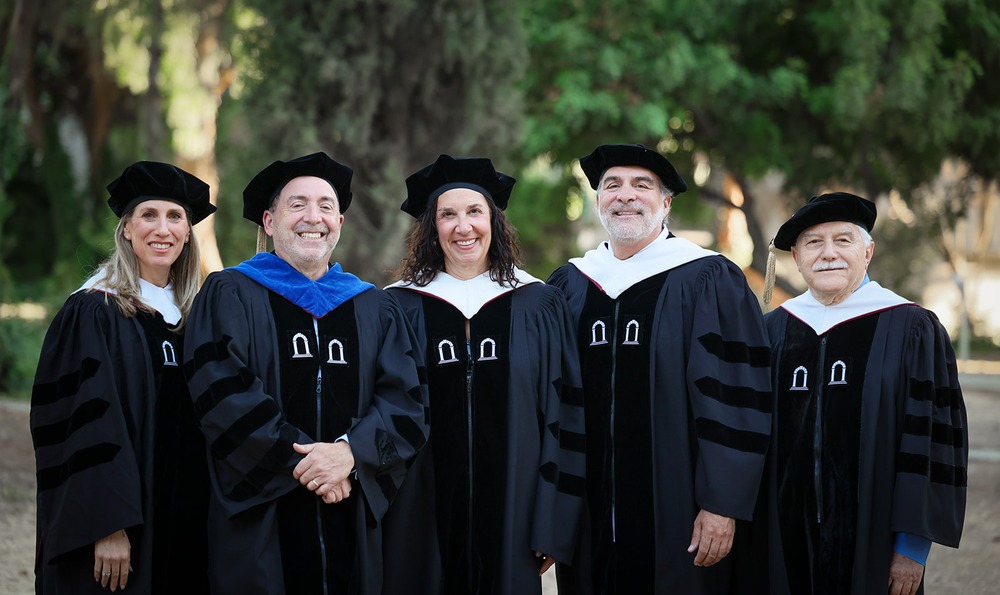
In his speech introducing honorary-degree recipients and pioneering college supporters Gil and Elisa Palter at the tenth Annual Shalem College Commencement on June 24, Chairman of the Board of Governors David Messer, pointed out that the couple’s very first gift to Shalem was, fittingly, one of books.
“Before buildings, before students, before everything else,” said Messer, the Palters gave “a gift of texts, of ideas [and] enduring wisdom.” Those texts—translations of classics of Western civilization, which Messer described as “themselves an act of nation-building”—would go on to become cornerstones of the Shalem curriculum, shaping the educational experience of nearly five hundred graduates since the college’s founding in 2013.
For the Toronto-based Palters, the bold idea that studying the great ideas of the past is the key to forging a better future is one that made perfect sense.
Explaining in his address that his own intensive study of the great Hebrew works was nothing less than life-changing, Palter said that his and Elisa’s decision to support the college grew out of an appreciation of “the value of wrestling with [these works’] lessons” and a recognition that studying one’s intellectual and cultural inheritance is essential to the formation of leading citizens for the Jewish state.
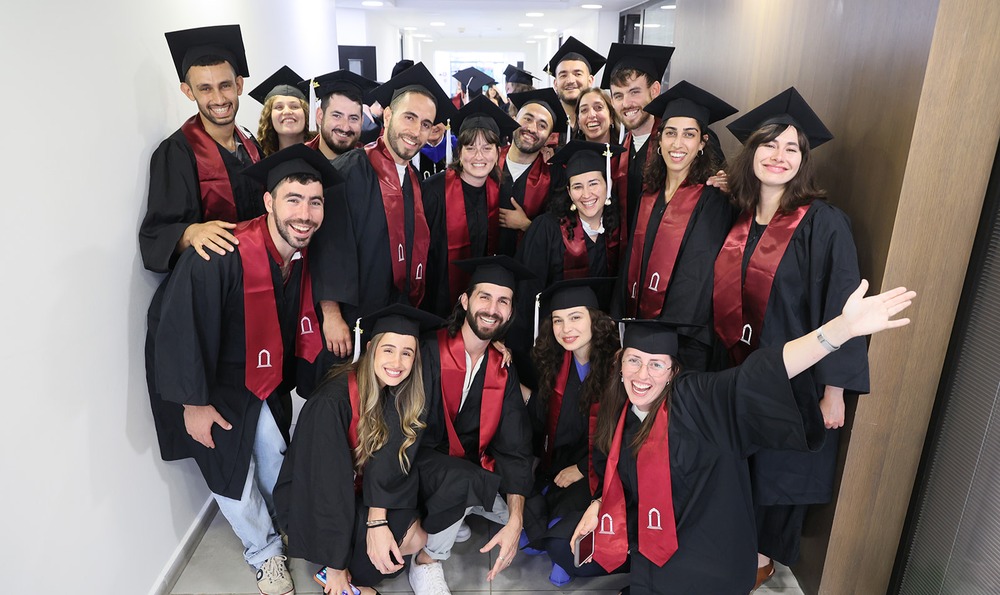
Looking out at the class of 2026—a class whose college experience was defined by war, and whose response exemplified the values Shalem was established to cultivate—there was no doubt that these were the leaders the Palters envisioned more than a decade ago.
“You have been tested in ways that previous classes were not,” President Russ Roberts told students in the ceremony’s opening speech. “You would be forgiven if you lost faith in our enterprise—the pursuit of truth, wisdom, and understanding. The ability to listen to those who disagree with you. The ability to hold on to questions without easy answers. You would be forgiven if in the face of war, you found what we do here too intellectual, too abstract.”
“And yet,” Roberts continued, “I never saw you waver from your purpose even once. I know you sometimes faced hardship and heartbreak. But you persevered. You did more than persevere. You stayed the course. You overcame.”
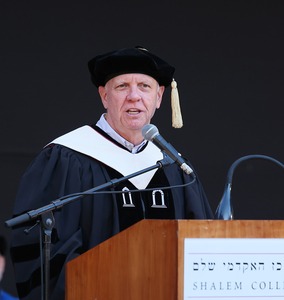
David Messer, chair of the Board of Governors
Shira Guetta ‘26 described the sense of inspiration she and her classmates derived from their studies against the backdrop of war. She traced the story of her class from its freshman-year encounter with foundational Western and Jewish texts through the Hamas attack on October 7, 2023, the death of their classmate Amir Skoury z”l, and the enlistment of nearly the entire cohort to the war effort—in combat in Gaza and Lebanon, in war rooms, in civilian command centers, and throughout the home front. The educational experience that awaited them upon their return to campus, she said, was different than the one they had begun.
“The desire for knowledge was still our driving force, but now we also had a more modest wish,” she recalled. “We wanted our learning to provide us with meaning [in the face of the] absence that had opened up within us.”
As she and her classmates discovered, the learning did that and more: It also revealed its relevance to their lives in ways they could never have foreseen. “Philosophy,” said Guetta, “granted the mechina (pre-military leadership academy) educators among us the ability to equip our own young students with a sense of purpose and a way to understand their country’s situation. Our studies in strategy, diplomacy, and Hebrew Bible connected students who served in intelligence to the story of the spies sent into the Land of Israel and that of Queen Esther in her plight to save the Jews.”
Even the sunlight streaming into the college library’s windows as students read classic texts came to feel, concluded Guetta, like a reminder “that there was no real partition between the classroom and the world outside.”
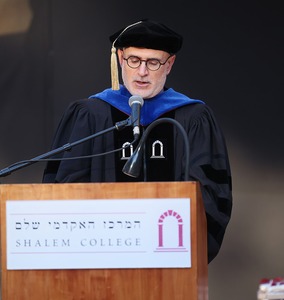
Dr. Ido Hevroni, chair of the David and Judith Lobel Core Curriculum
For Ido Hevroni, chair of the David and Judith Lobel Core Curriculum and lecturer of Western literature and Talmud, the new reality into which Israelis were thrust on October 7 underscored the relevance of the humanities that Guetta described. “The ideas we discussed theoretically in the first year of school turned into burning questions when we returned in the second,” Hevroni said. “What happens to soldiers who participate in war? What happens to the house left behind? And how does our turbulent historical moment fit into the chain of Jewish generations?”
These questions, recalled Hevroni, especially preoccupied Amir Skoury z”l, an officer in the IDF’s elite commando unit Sayeret Matkal. Skoury fell defending residents of the Gazan border communities from Hamas terrorists after rushing to the front on October 7. Describing Skoury’s final paper for his course on Homer’s Odyssey, Hevroni said, “Of the many themes that arise in the Odyssey, Amir chose to emphasize the question of the son: Is he the worthy heir to his legacy? After we returned to school, some of you read Goethe’s Faust, which reinforces the answer that Amir found: ‘What you inherited from your ancestors, you must acquire in order to make it your own.’ This is what Amir recognized in [the Odyssey’s] Telemachus. The worthy heir is not passive but active. This is the journey that Amir took, and that all of you have taken too. You risked your lives, you volunteered and toiled, and you proved that you are worthy heirs of the traditions we are learning here.”
The theme of a worthy heir was taken up by the ceremony’s other honorary-degree recipient: Shira Shapiro, then-deputy director general of the Ministry of Heritage, architect, and mother of Aner Shapiro z”l, who was murdered while saving lives at the Nova music festival. For Israelis, the image of Aner standing at the front of a packed bomb shelter, throwing live grenades back at the Hamas attackers, placed him firmly in the pantheon of heroic figures stretching from ancient Greece to modern Israel.
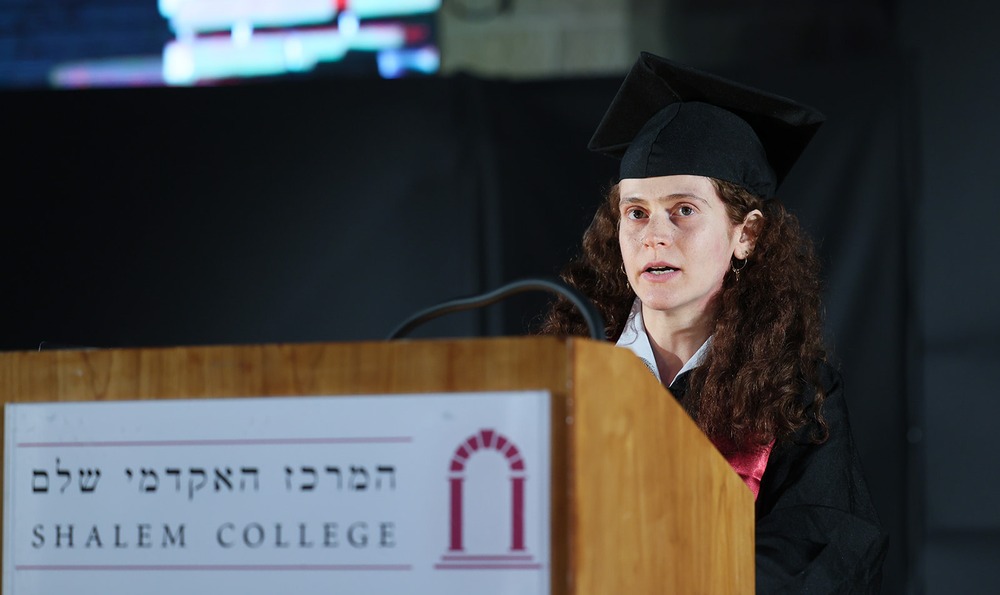
Shira Guetta ’26
Noting that “heritage, like any field, can be purely scholarly, a monument to the past,” she said that “it can also be an active bridge between the past and the present, and the present and the future to come.” In the days and weeks after October 7, she explained, her ministry insisted that discussions with Gaza Envelope kibbutzim focus first on commemoration, and only after on budgets and logistics for rehabilitation. “Suddenly, memory became an existential need. Commemoration became the responsibility of countless people who had lost loved ones. Heritage became a foundation of belonging, a shared story, and a basis for genuine resilience.”
Noting her family’s personal connection to these tragic days and hours, she continued: “Our eldest son, Aner, ascended to heaven in a storm while defending others with his bare hands and flip-flops. Since then, Aner has become known as a symbol of heroism—a heroism of spirit. But Aner’s legacy is far richer than that. It is not only the legacy of his final hour, when he chose to sacrifice his life in order to save others. It is also, and perhaps primarily, the legacy of how he chose to live his life.”
She concluded with a call to students to believe in the possibility of a different future—and in their ability to make it happen. Quoting from the lyrics of one of Aner’s songs, Shapiro insisted, “We have not reached the point of no return/The realization of our vision depends on us.”

In the spirit of transforming memory and loss into a catalyst for positive change, Hevroni announced, toward the end of the ceremony, the college’s creation of the annual Amir Skoury z”l Scholarship. Selected by a faculty committee, and awarded to a student at the beginning of his or her final year of study, the recipient will have demonstrated the qualities and commitments that defined Amir: intellectual curiosity and growth, leadership, distinguished military service, and a deep commitment to the flourishing of the State of Israel.
Calling upon all members of Shalem’s tenth academic class to make the most of the privilege their education has granted them, Elisa Palter pointed out, “In a small country like Israel, it doesn’t take millions of people to make a difference. It takes a small number who care enough, who think deeply enough, and who are willing to act. And Shalem,” she concluded, smiling at its newest graduates, “creates those people.”