
Student Representative Tal Eitan Urges Fellow Classmates to Better Israeli Society
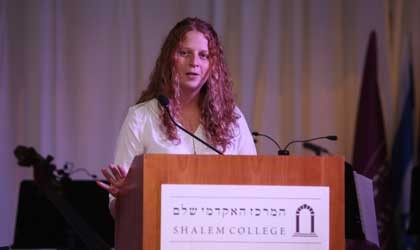
“Poverty,” declared Shalem student representative Tal Eitan at the college’s October 6 opening event, “is not just financial. The most debilitating kind of poverty is actually cultural. Without education—political, economic, social; the kind that goes beyond mathematical equations and report cards—there can be no genuine freedom.” A more free society, in which individuals are able to make informed, meaningful decisions affecting their lives and those of their fellow citizens, is precisely what Tal hopes to achieve by means of her next four years at Shalem.
Tal, 25, began her speech by describing her colorful background, and the winding path that led her to the podium on Sunday evening. “When I was a year old, my father decided to realize a long-held dream: to establish a farm in the Negev,” she recalled. “Life for those few years on an isolated farm and the hardships that went with it taught me the true meaning of authenticity—of acting on my own beliefs, instead of following the crowd.” After graduating from the prestigious Hebrew University High School in Jerusalem, Tal elected to study at both the Nachshon and Ein Prat pre-military academies, where she recently returned as a teacher.
It was her role as an officer in the IDF’s Education and Youth Corps, however, that provided the impetus for her decision to seek out an intensive education in the humanities. Tal was an officer on the Havat Hashomer training base, which seeks to help recruits from disadvantaged background become full, productive members of the army and of society as a whole. There, she explained, she was astounded by the soldiers’ lack of familiarity with both Jewish tradition and Israeli culture. “Suddenly it was clear to me that I need to know who I am before I can decide what I am. I was thirsty for knowledge,” she continued, “and I realized that Shalem is the only institution capable of quenching it. The aspiration to be a decent human being, and not just a materially successful one; the desire to seek out truth beyond any historic or social context; and to the determination to study without cynicism, and with genuine open-mindedness—all these led me to choose Shalem College.”
Tal concluded with her hope for her fellow students: “I hope we learn how to fix ourselves before attempting to fix the world. For our world needs fixing, and it needs good people—people of vision and action, people courageous enough to dream that things can be different.”


