Shalem’s First Art Installation Forms Unique Backdrop to Studies
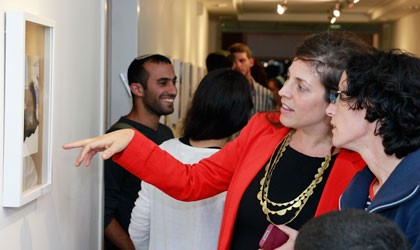
When students arrived on campus for the commencement of studies this semester, they were greeted by a new addition: An art installation that “narrates visually the story of the first year of studies,” explains Director of Culture, Community, and Society Dr. Stephen Hazan Arnoff. A gallery of 13 paper-cut collage portraits and a twenty-two page magazine based on classic texts and student commentaries, the installation, which was inaugurated with a festive opening on October 23, is the result of the cooperative efforts of Shalem’s first artist-in-residence, the established community artist Anat Litwin, and 30 members of Shalem’s inaugural class.
The installation, exhibited along the main hallway of the college’s first floor, showcases the figures and texts that most influenced students’ experience, from Aristotle to Cyclops and the biblical Samson, through an abstract combination of rough paper-cut designs and magazine cuttings. Intended, in Litwin’s words, to “reveal the transformation these figures undergo in the process of students’ engagement with them, from something vague and distant to something deeply personal, with relevance for them here and now,” the materials used deliberately reflect their contemporary provenance, and provide a startling contrast with the ancient (Greek, Hebrew, and Islamic) subject matter.
The months-long process of creating the portraits began with a series of meetings between Anat, her collaborator Yehudit Shlosberg-Yogev, and Dr. Hazan Arnoff, who explained the unique Shalem core curriculum and ways in which the seminar format encourages meaningful interaction with the texts and ideas under study. Litwin, who serves as director of Beita: the New Home for Art, a Jerusalem-based initiative to foster ties between artists, the public, and the city of Jerusalem, then worked closely with three Shalem students to explore ways in which great artists and movements of the past represented ideas in their works, and to devise a medium appropriate for the Shalem installation. Finally, on the last day of classes, Litwin and Shlosberg-Yogev interviewed 30 students to determine which figures and texts had made the most impact, and which best stood for the Shalem first-year experience.
The result, which was unveiled at an opening for both returning and incoming students on October 23, was so well received, “it’s clear that the artist-in-residence approach is the right one for us, and one with which we’ll continue in the years to come,” said Dr. Hazan Arnoff. “Every opportunity we have or can create to encourage serious reflection and self-expression among the students, and to help them create their own community of shared experiences and endeavors, we’ll take.”