
Shalem Receives Legacy Gift from Legendary Educator Eva Brann z”l
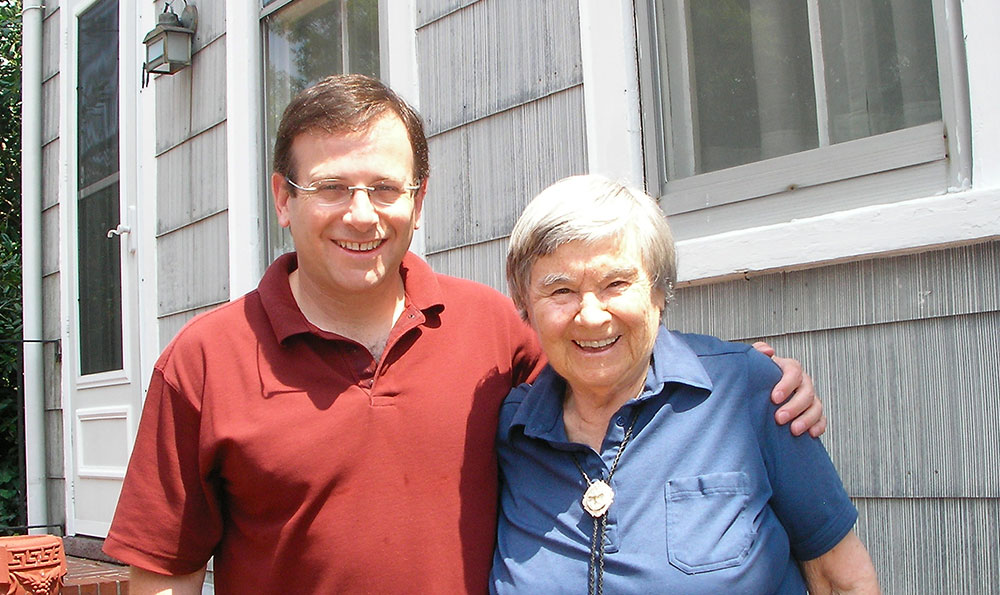
Arriving one afternoon to his St. John’s Summer Institute seminar on Thomas Mann’s Joseph and His Brothers, St. John’s College graduate Jed Arkin noticed a complicated math problem worked out on the classroom’s chalkboard. Halfway through class, Arkin—an entrepreneur, venture capitalist, and longtime member of Shalem’s board—realized that the math problem was none other than the so-called Dagantakala field measurement Mann has Joseph solve in his book. “I realized immediately what had happened,” he says. “Eva [Brann] had come to class early, and driven by nothing more than sheer intellectual curiosity, she had worked out the math described in the book and confirmed that it checked out.”
For those who knew Eva Brann, the National Humanities Medal winner, longest-serving tutor at St. John’s College in Annapolis, and friend and mentor to Shalem College, this type of engagement with the text was simply par for the course. It was also, as Shalem Dean of the Faculty Prof. Lean Kass explains, why Brann, who passed away in late 2024 at the age of 95, was an ardent supporter of Shalem’s unique approach to pedagogy in Israel. Last month, Shalem received word of a six-figure bequest from her estate.
“Eva taught the Great Books seminars into her nineties and she lectured and published on every conceivable subject, from ancient Greek poetry and Plato’s dialogues to Jane Austen and America’s founding documents,” says Kass, who knew Brann for more than fifty years, four of which he and his late wife Amy spent teaching as her colleague at St. John’s. “Yet there was such an incredible freshness to her reading and conversation. She took the same delight in learning a text as one hopes to see in an undergraduate exposed to new worlds of knowledge for the first time.”

Eva at a visit to Masada
He notes that the last time he saw her, though she was confined to bed, she nonetheless wanted to hear all about her beloved liberal arts college in Israel—Shalem.
“Eva played an important role in our early efforts to adapt the Great Books approach to the Israeli context,” says Shalem Executive Vice President Dr. Daniel Polisar. Indeed, as part of a pilot in the months before the college’s official opening, Brann—herself a Jew of German extraction, whose family fled to America to escape the Nazi regime—came to the college to teach master seminars to Shalem faculty. “Since the approach at most Israeli institutions of higher education is one in which experts transmit knowledge, rather than engage students as partners in the quest for wisdom, Eva’s modelling of the American liberal arts tradition was an eye-opening experience,” Polisar explains. In so doing, she “strengthened the ability and commitment of our faculty to making text-based conversations the centerpiece of a Shalem education.”
Dr. Ido Hevroni, chair of the David and Judith Lobel Core Curriculum, agrees wholeheartedly. Having led a delegation of Shalem faculty to St. John’s in 2013, Hevroni remembers Eva stressing the importance of “ensuring that students aren’t worried about how they sound in class,” he says. “She insisted that only when students are comfortable revealing what they don’t know will they be willing to speak authentically.”
In particular, he notes how Eva responded to a question by Dr. Asael Abelman, a Shalem lecturer of Jewish history. “Asa asked how much [St. Johns’] lecturers know about their students’ personal challenges. Eva responded that often students come to her with philosophical questions, and it’s clear that what’s motivating them is something deeper, like a breakup or a disagreement with one’s parents. She said that this is exactly what she wanted: for students to become accustomed to dealing with things on a deep and serious level, not the shallow level of day-to-day life. Why,” Hevroni says she concluded, “do we read the great books, if not to learn how to use the concepts that they articulate?”
Perhaps not surprisingly, Arkin believes that much of what Eva loved about Shalem was the students, and the unique perspectives and insights they could bring to the texts she loved. “Shalem students have contributed so much to their communities and their country, particularly during the last two years of their country’s existential war. And they bring that sense of urgency and those transformative life experiences to their discussions of the texts in class. That makes for incredible seminars, which far surpass the ones I remember from my own days at St. John’s.”
Then he adds with a smile, “I know Eva would have loved nothing more than to have learned together with them.”


