Government Ministers, Scholars, and Philanthropists Turn Out to Wish Students Success at Shalem College Opening Exercises
Government ministers and renowned scholars, Israel-Prize laureates and philanthropists, and the members of Israel’s Revolution Orchestra joined Shalem’s first class of students and their families for the college’s opening ceremonies at its Jerusalem campus on October 6. Hailing the moment as a milestone in the history of the Jewish state, Shalem President Martin Kramer described the incoming freshmen as “true pioneers,” whose choice of the college “indicates their independence—a characteristic of leaders in every area of life.”
Yair Shamir, decorated IDF pilot and high-ranking air-force officer, successful businessman, and current member of Knesset, led the roster of prestigious speakers at the invitation-only event with an impassioned speech about Shalem’s vision of a liberal arts education for Israel. Describing the “enlightened leadership” that would emerge from among the college’s graduates—the result of learning “based on values, a connection to the classic Jewish and Western sources, and a profound understanding of the region in which we live”—Mr. Shamir, who previously served as the chair of Shalem’s International Board of Governors, insisted that their “spiritual strength” would prove as crucial to Israel’s survival as its economic and military might.
Joining Mr. Shamir onstage was Minister of the Interior Gideon Sa’ar, who praised Shalem’s goal of creating a model of vibrant civil discourse: “It is impossible,” Sa’ar stated, recalling the words of the economist John Stuart Mill, “to conduct an investigation of the truth without a plurality of opinions.” Former Knesset member Dr. Einat Wilf, herself a product of a liberal-arts education from Harvard, noted that the study of the liberal arts cannot but spur students to live more worthy lives, making for better individuals, communities, and countries.
Influential philosopher Asa Kasher, winner of the prestigious Israel Prize and co-author of the IDF’s Code of Ethics, remarked that Israel’s first president Chaim Weizman, in a 1918 journal entry, viewed the establishment of the Hebrew University as equal to King Faisal’s recognition of the Zionist enterprise in heralding the future birth of a Jewish state. “We are preoccupied with the routine necessities of life—security, economics, health,” stated Kasher, who will be teaching a course on philosophy as part of Shalem’s Core Curriculum this coming year. “But Weizman understood that the pursuit of wisdom is not a luxury.” Indeed, Kasher insisted, the spirit of learning “pulsating within Shalem College…will contribute to the collective, influencing all its endeavors for the better.”
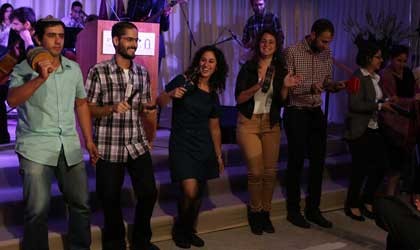
In keeping with Shalem’s commitment to the study and appreciation of the arts—and to both tradition and innovation—the more than 400 guests at the opening event were also treated to an unexpected musical interlude: a symphonic flash mob, choreographed by Israel’s cutting-edge Revolution Orchestra. Under the direction of composer and Shalem faculty member Roy Oppenheim, who will teach music as part of the Core Curriculum, the spontaneous performance of a selection from Edvard Grieg’s In the Hall of the Mountain King concluded with a grand finale: Shalem students and faculty joining the musicians on stage, percussion instruments in hand.
In his concluding remarks, Dr. Daniel Polisar, Shalem Executive Vice-President and Provost, stated that the combination of an exceptionally talented and motivated student body and a uniquely challenging curriculum, which “thoughtfully integrates contemporary Israel, Jewish tradition, and the reality of the Middle East,” will produce a cohort of leaders both ready and able to help the Jewish state navigate the complex challenges that face it, today and in the decades to come.