Why study the liberal arts? Acclaimed historian Paul Rahe offers students an inspiring answer
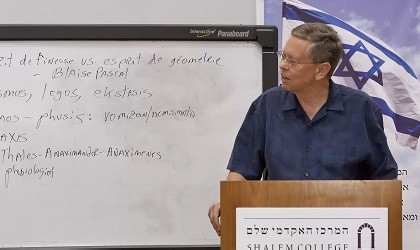
The liberal arts, including philosophy, history, political science, and literature, “invite us to put ourselves imaginatively in situations we have not encountered, and to ruminate,” explained renowned historian Paul Rahe during his keynote lecture for Shalem’s English Immersion Program. “What did these characters and these historical figures do when faced with such and such a situation? How could they have done better?” For Prof. Rahe, herein lies the true value of the humanities to mankind, and the reason why modern students should struggle with the great classic works. It is also the animating spirit behind a celebrated career as one of the greatest scholars of Western civilization in American academia today—a career best summed up by his title at Michigan’s prestigious Hillsdale College: Chair in the Western Heritage.
Prof. Rahe is author, among other works, of the landmark text Republics Ancient and Modern, which traces the origins and development of republicanism from the ancient Greeks through to the early American Republic. Known for exposing the antagonism of early modern political theorists to certain classical republican principles, Republics went on to demonstrate these theorists’ impact on the succeeding Anglo-American political and constitutional traditions. In his week-long seminar for Shalem’s English Immersion Program, which focused on the origins of the American political tradition, Rahe focused on an aspect of that tradition to which Israeli society could easily relate: its efforts to deal with, and accommodate, sectarian religious divisions.
A Yale-educated Rhodes Scholar, Rahe earned his doctorate in the classics under Prof. Donald Kagan, considered one of the world’s foremost scholars of ancient history. Yet as Shalem students learned during their week with Prof. Rahe, there is no period in Western political history about which he cannot offer an insightful, intellectually stimulating, and clear-eyed view. For one student, the most enjoyable part of the course was also the most surprising: The introduction to the thought of Hobbes. “I knew him as a political philosopher, but after Prof. Rahe’s course, I realized that he had incredible insight into the psychology of human behavior, and that his political theory derived from a very sophisticated and convincing understanding of human nature and desires,” he said.
When asked if it’s really possible to gain an understanding of the American political tradition in just a week’s time, the students’ answer was an emphatic yes. One student explained why: “We started the week with Machiavelli, and then began a whirlwind tour through Hobbes, Locke, Montesquieu, and the authors of the Federalist. Learning about each of them in such an intense way, and during such a short period of time, drove home the fact that they are all part of the same conversation. Their lives and thought may have spanned more than two centuries, but in essence, they were speaking to each other. Revealing those connections is the essence of what we’re doing here, and why learning at Shalem is such an intellectually inspiring experience.”