
Cultivating a New Generation of Zionists, One Orchard at a Time
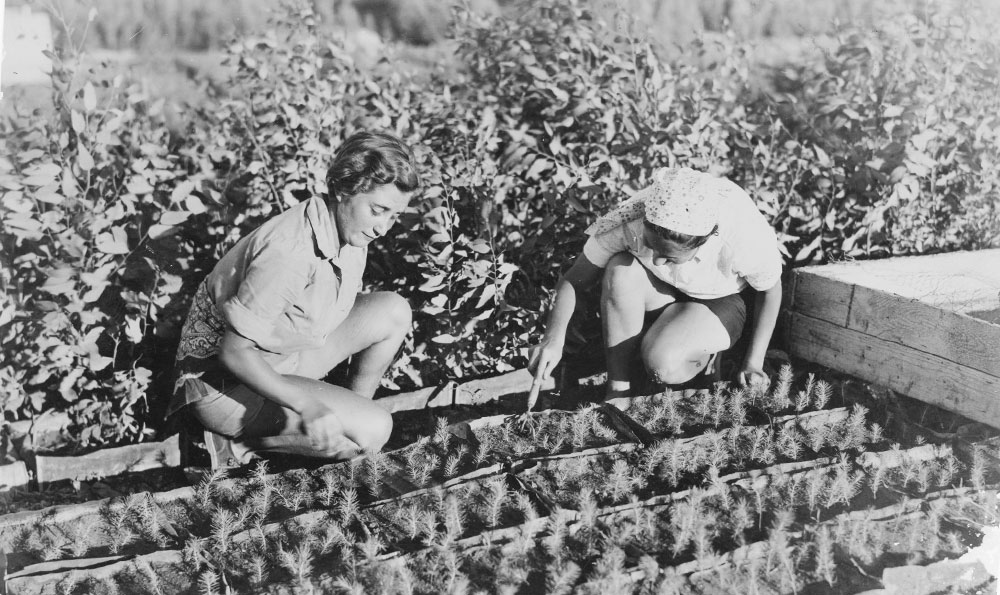
When, a year ago, the Jerusalem Municipality erected its famous blue heritage-site sign at Armon Hanatziv’s Maiden’s Farm, Noam Schreiber ’20 considered it a victory—and not only for the farm itself. As the leading force behind the revival of a nearly century-old agricultural-Zionist project, Schrieber insists that the step was a victory for the neighborhood, for all Jerusalem residents, and ultimately, for Israeli history.
“This area was home to the Israeli literary giant Shai Agnon and historian Joseph Klausner,” notes Schrieber, who first learned about the neighborhood when she arrived in Jerusalem to begin her freshman year at Shalem. “The earliest residents were true pioneers who laid the foundations for a Jewish state. And among them were Rachel Yanait Ben Tzvi and her ‘maidens,’ who forged a connection between Jewish refugees, the vision of Jewish statehood, and the cultivation of the land itself. It’s about time,” she concludes, “that her farm take its place in our national story.”
And just as that story is still unfolding, so, too, does Schreiber seek to make Yanait’s farm much more than a memory.
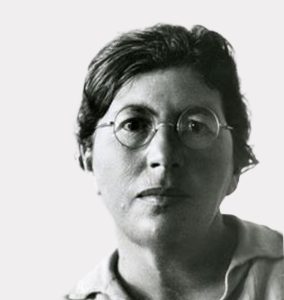
Rachel Yanait Ben Tzvi
“I discovered the existence of the farm—which was then just a few abandoned buildings and the derelict land around them—during my orientation at Shalem,” recalls Schreiber. “[Chair of the David and Judith Lobel Core Curriculum] Dr. Ido Hevroni took us freshmen up to the roof of the college building, and pointed out that right next door, in the decades before the establishment of the state, a group of young women from Europe, Lebanon, Syria and other places came together to turn their energy and ideals into a thriving agricultural school.”
The connection to Shalem’s mission wasn’t lost on Schreiber (“These women believed in combining study with action,” she says, “which is also a core value at Shalem”), who filed away the site’s story while she focused on her chosen major, Middle Eastern and Islamic Studies. After graduation, she and her husband remained in the college vicinity. Schreiber began working at the Israeli Center for Young Leaders, a national nonprofit that develops leadership skills among outstanding, Zionist-minded Israeli youth; at the same time, she and her husband played a key role in the establishment of “Mitzpetel,” the urban nature preserve that stretches between Armon Hanatziv and the adjacent Arab village of Sur Baher. It was while participating in a social-venture incubator for the two neighborhoods’ women that Schreiber finally decided to turn her attention to that “enchanting, neglected farm” she’d spied her first week at Shalem.
“I really identified with Yanait’s purpose,” she says. “Instead of leaving the city so I could enjoy nature, I wanted to bring nature to Jerusalem. Or, in the case of Maiden’s Farm, to bring it back.” Since the ownership of the original school buildings and land wasn’t clear, Schreiber explains that she wasn’t sure where to begin. In classic Shalem style, she naturally turned—to the past.
Schreiber started studying the history of the farm in depth at Yad Yitzhak Ben Tzvi, a Jerusalem-based research institute that focuses on the history of the city. Armed with information, Schreiber began to offer tours of the site. Thanks to their popularity, the tours were eventually brought under Yad Yitzhak Ben Tzvi’s auspices, which raised awareness of the farm among a larger audience. With the help of volunteers—including local Bnei Akiva youth groups, mechinot (pre-army leadership academies), and students from Shalem—she then began to restore two of the site’s original orchards, plowing and planting land that had laid fallow for nearly seventy-five years.
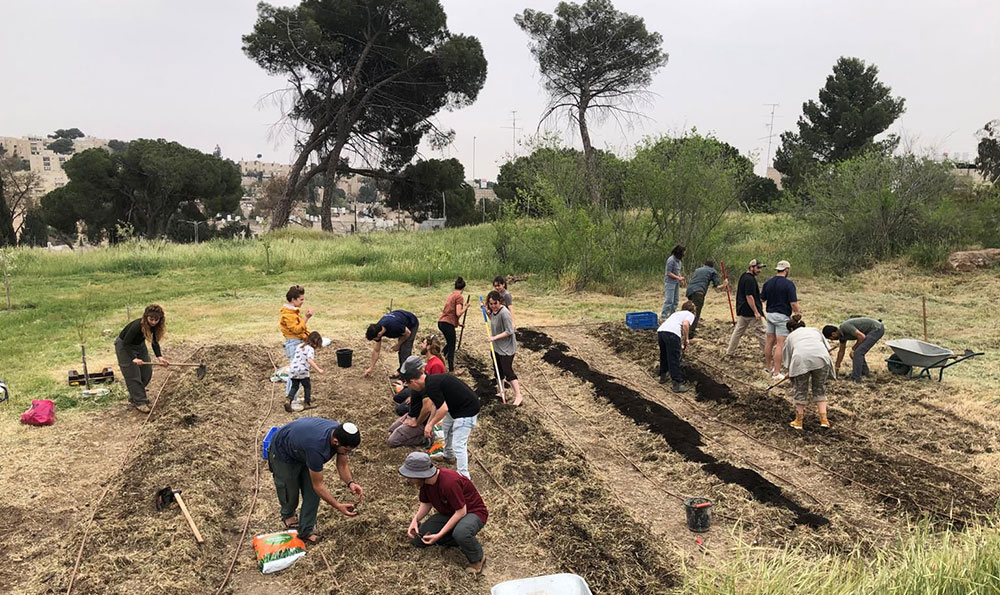
Student volunteers restoring the farm’s original orchards
“There is something very special about working the land, especially for people like myself who have returned from extended miluim [reserve duty] during the war,” says Theo Brand ’27, a reservist in one of the IDF’s elite commando units. Together with Yasmin Kopelman ’27 and Itai Shternshein ’27, Brand is part of the Maiden’s Farm leadership team. The great-grandson of founding members of Jezreel Valley’s Kibbutz Ein Harod, Brand is the fourth generation of his family to call the kibbutz home—a background, he explains, that taught him the importance of agriculture to developing a sense of rootedness. “You may think you’re just restoring a site, but the act of cultivating land in truth restores you instead. It nourishes your spirit and reminds you of your larger purpose.”
Brand coordinates joint projects at the farm with groups such as the Zionist-agricultural nonprofit Hashomer Hahadash and organizes therapeutic programs for returning reservists, many of them students at Shalem. In addition, and with the help of Kopelman and Shternshein, he oversees the almost thirty Shalem students who spend several hours a week cultivating the farm’s orchards and the groups of local schoolchildren who arrive to learn about farming and their city’s history.
Ultimately, the Maiden’s Farm team seeks to renovate the site’s three buildings and turn them into a center for Jerusalem’s agriculture, sustainability, and Zionism ecosystem. This goal was the reason for Schreiber’s application to Shalem’s Gracefield Fellowship in 2024, which grants alumni funding and a summer residency on campus to advance projects with the potential for social impact. During her time at Shalem, Schreiber developed plans to produce a documentary about the farm’s history. She and her team plan to use the film to raise awareness among city residents, policymakers, and donors—all of whom, she insists, will prove critical to ensuring the site’s preservation.
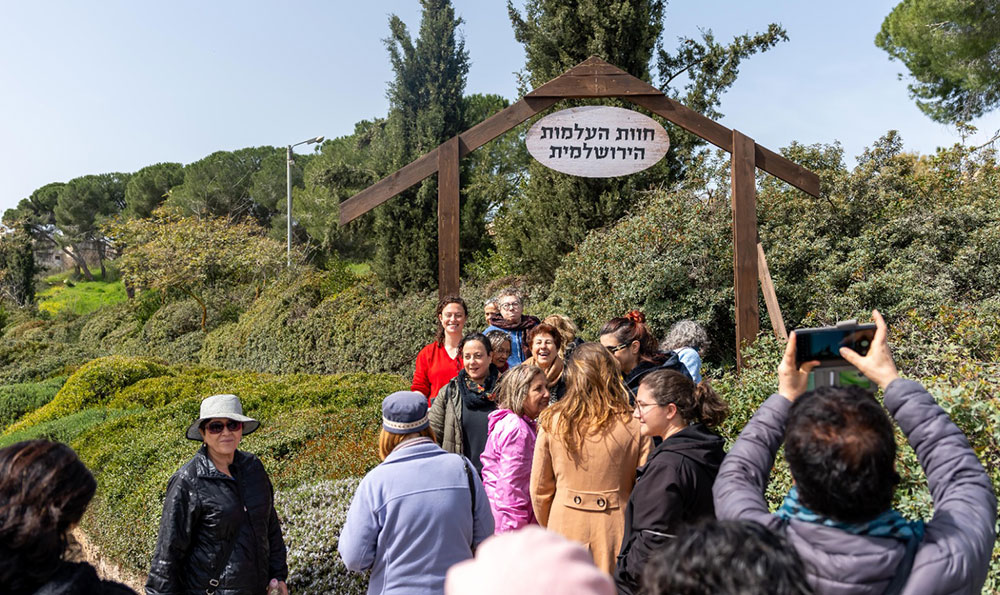
The farm’s reinauguration
“The municipality’s future plans for the city include building a hotel on part of the farm’s land,” she said. “But that was before we began restoring the site.” She explains that now that the municipality sees the farm’s value to the local and national community, they’re working closely with Schreiber and her team to find a solution.
“The more the farm flourishes, the better our chance of success at preserving this prime real estate for historical, educational, and agricultural purposes,” adds Brand.
Meanwhile, the farm is already providing the backdrop for the cultivation of tomorrow’s pioneers: This past October, it was the site for Shalem’s freshmen orientation. “I can’t think of a better place for Shalem students to begin their journey,” says Schreiber. “In shaping Israel’s future, we should always keep in mind the dreams, sacrifices, and just plain hard labor that went into shaping its past.”


