
Columbia’s Roosevelt Montás and St. John’s Eva Brann Share Unique Approach to Teaching with Shalem Faculty
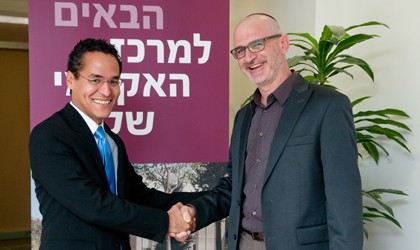
This winter, Shalem College hosted two leading ambassadors of the American Great Books model, part of its ongoing series of encounters between college faculty and renowned figures in liberal arts education from abroad. In January, Eva Brann, former dean and the longest-serving tutor at St. John’s College, visited Shalem to share her distinctive student-centered approach to learning. In March, Roosevelt Montás, the Director of the Center for the Core Curriculum at Columbia University, discussed both the practical aspects behind, and his personal commitment to, developing a core curriculum.
Montás, a professor of American Antebellum literature, was recently tasked with integrating multi-cultural courses into Columbia’s famous core curriculum. Explaining that his own ethnic and economic background allows him to appreciate students’ desire for a core that “embodies diversity,” he is also a passionate defender of a traditional core, which “ought to represent” the “most important ideas that have shaped the institutions and values of our culture.”
During his March 14 visit to Shalem, Montas led faculty in a Columbia-style seminar on Kant, followed by a roundtable discussion of the university’s core curriculum. Admitting that the core “is how I make sense of my life,” the Dominican Republic native insisted that such a course of study can be a life-changing experience, connecting students not only across disciplines, but also across generations. A core, he maintained, grants them the sense that they are part of, and have an equal stake in, Western culture. Montás also credited a robust core curriculum with countering the trend toward overspecialization in contemporary academia, and reminding students of the importance of a “meta-disciplinary,” and not merely “inter-disciplinary,” outlook on the world. Commenting on the visit, Shalem Educational Director Ido Hevroni declared it “a testament to the interest that leading institutions abroad are taking in the creation of a liberal arts college in Israel.”
Eva Brann visited with Shalem faculty on January 14-15, bringing lessons from the distinctive student-centered approach to learning prevalent at St. John’s, the premier non-denominational Great Books college in the United States. Brann, a 2005 recipient of the National Humanities Medal, has played a key role in developing St. John’s unique curriculum, which itself has provided an important pedagogical model for Shalem. Emphasizing the importance of requiring students to go straight to the sources of the Western tradition, and to discuss, in the context of small seminars, the classics of such disciplines as literature, philosophy, theology, economics, and history, Brann maintained that students who emerge from this sort of educational experience exhibit a fearlessness when confronted with the unknown. Shalem board member and St. John’s alum Jed Arkin, who participated in Brann’s visit, agreed, crediting the liberal education he received there with his ability to confront complex, unfamiliar challenges, and question the opinions of “experts” over the course of his business career.
During her time at Shalem, Brann led faculty in a Great Books seminar on Jane Austen’s Pride and Prejudice, demonstrating the sort of intellectual engagement that can only occur absent a reliance on textbooks, and without the distancing format of large lectures. She also shared suggestions for engaging students fully in their studies, such as her insistence that professors make themselves as available as possible outside of class for impromptu conversations, and her belief in the need for a shared educational philosophy among faculty members. She praised Shalem College leadership for its initiative in establishing the faculty development program, which seeks to create a vibrant, cohesive group of colleagues dedicated to the liberal-arts model. “It’s incredibly encouraging that influential educators such as Eva Brann are supportive of what we’re trying to do here at Shalem,” said Menachem Kellner, Chair of the Interdisciplinary Program in Philosophy and Jewish Thought. “It’s also great to see how receptive Shalem faculty were to her ideas, and how much they’re looking forward to applying them.”
Photos of Roosevelt Montás’ visit to Shalem can be viewed here.