A Neighborhood, and a World, Away in Jerusalem’s Ein Kerem
Considered by the Christian tradition to be the birthplace of John the Baptist, Ein Kerem, a pastoral neighborhood nestled in the Jerusalem hills, boasts a cluster of churches and Crusader fortresses that draw a steady stream of Christian pilgrims throughout the year. Few are the Israelis, however, who know the neighborhood as more than a place for a Friday-morning stroll through eclectic art galleries or a night out at one of its hipster bars; fewer still are those who seek out encounters with Ein Kerem’s Catholic community, tucked away as it is in the village’s quiet monasteries and secluded gardens. Fortunately, as part of the month-long English Immersion Program this past July, Shalem students were offered a rare glimpse into a very different world of faith, and encouraged to see their city from its very different perspective.
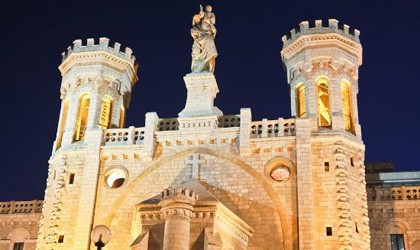
After a tour of the remains of the first sanctuary erected over the traditional site of John the Baptist’s birth, students were welcomed by the nuns of Notre Dame de Sion to their convent, which houses a community of contemplative and apostolic sisters, and, of late, a community of monks as well. The convent’s history, they explained, dates to the middle of the nineteenth century, when it was established as a refuge for orphaned girls from Lebanon; later, it served as a school for young Arab women. Today, as well as serving as a guesthouse, it engages in both formal and informal Jewish-Muslim co-existence programs, with the aim of providing a “safe,” nurturing space for interfaith dialogue.
“It was eye opening to discover this enclave in a city I thought I knew so well, and to hear a completely different perspective on the people and the life here,” said student Tammy Gelbart. “The real benefit of this and the other tours we’ve done as part of our Immersion Program is that they’ve taken us out of our comfort zone and shown us that Jerusalem, and by extension Israeli society in general, is so much more complex and diverse than we realize. It’s one thing to hear it said,” she concluded, “but another thing altogether to experience it firsthand.”