From India to Israel, Planting the Liberal-Arts Tradition on Foreign Soil
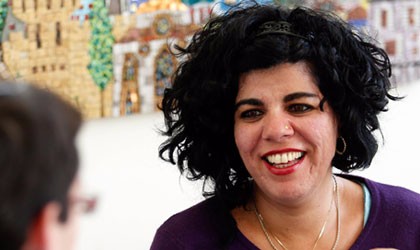
For Naama Shalom, a scholar of Indian thought and Sanskrit literature, the moment when the full force of Indian culture’s divergence from the Judeo-Christian tradition became clear was in the Ganesh Temple in Rajasthan. “This temple, which is associated with the lower castes in Indian society, is dedicated to the rat. When I entered—with my shoes off, as per Hindu custom—I was horrified to see hundreds, if not thousands, of rats scampering around. Because they’re considered a Hindu god, the priests were feeding them, and the visitors were eating the remains of the food the rats had left behind. It was,” she concludes wryly, “a lesson in opening one’s mind to the world beyond the familiar.”
Dr. Shalom first “caught the India bug,” in her words, during her travels through the sub-continent after her army service. It was then that she decided to study the religions, philosophy, and culture of one of the world’s most ancient civilizations, which she did, first as a student at the Hebrew University of Jerusalem, and then at Oxford University, where she earned her doctorate by producing a new interpretation of the final sections of the epic Sanskrit poem the Mahabharata. When, in 2014, the O. P. Jindal Global University in Dehli opened a unique program—a liberal arts college—Dr. Shalom was recruited as one of its academic founders, a position she considered both a privilege and an enormous challenge. “As India turns increasingly toward the West, its youth is encouraged, almost exclusively, to seek out training in computer programming and the hard sciences as the key to competing in a global market. The result,” she concludes, “is a generation of Indians who know very little about their own culture, and the unique contribution it can make to the world at large.”
Fortunately, enthuses Dr. Shalom, the seeds of change have taken root, and the liberal arts movement in India is beginning to spread: Concurrent to the Jindal School of Liberal Arts’ opening, a competing college opened its own program in the humanities. Slowly, she believes, Indians will come to recognize the complementary value of a broad-based education, one that encourages free thought even as it instills a respect for one’s own cultural identity and tradition—much as the students at Shalem, Israel’s first liberal arts college, have done. “I really, truly believe in what Shalem is trying to do. Not only the curriculum, but the entire educational approach, with its emphasis on superb teaching and on active, seminar-based learning, is revolutionary. I see the effect that Shalem has on its students, who are as eager and excited to learn as they are about contributing to their community and their country. It’s fantastic.”