
Of Drones and Paradigm Shifts: Shalem Alum Brings Innovation to the IDF
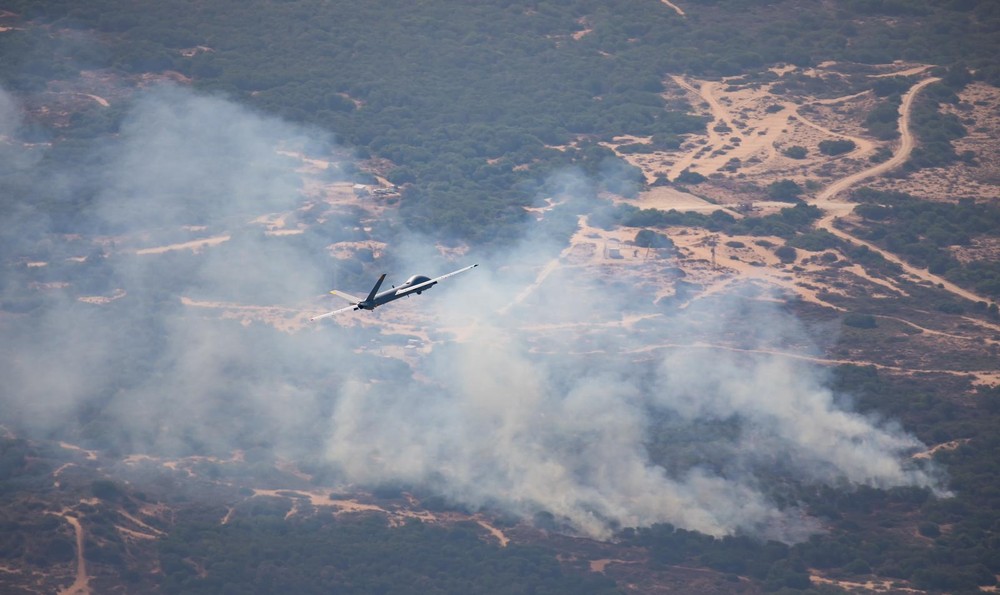
“We are in the middle of a paradigm shift,” says Major D. ’23 about the Israel Defense Forces. He’s sitting in his office in the Air Force Headquarters, where he serves as deputy commander of its sixty-soldier Drones and Robotics Unit. “Today, a strong army isn’t defined by its tactics and fighting forces alone. Strength also requires quick adaptation.”
Unfortunately, “quick” and “adaptation” aren’t words usually associated with massive bureaucratic entities.
“That’s changing,” insists D., who graduated from Shalem’s Program in Philosophy and Jewish Thought after first serving for nearly seven years in an elite IDF commando unit, and then for another three years as a unit innovation manager, responsible for driving entrepreneurship. “The IDF is becoming a different kind of army. I’m here to expedite that shift.”
It can’t come a moment too soon. Since April’s ceasefire between Israel and Hezbollah, the terror group’s use of explosive, first-person view and thermal drones has posed a lethal threat to IDF soldiers operating in southern Lebanon. This technology—the foundation hardware for which is largely purchased on Chinese e-commerce platforms like AliExpress—has already claimed the lives of more than a dozen Israeli soldiers. This, despite both active and passive countermeasures, including the use of hundreds of thousands of meters of wire mesh nets to trap propellers and provide a physical buffer.
For D., who leads efforts to facilitate R&D collaborations between the IDF and private companies, the need to accelerate solutions to Israel’s drone vulnerability perfectly encapsulates the challenge of optimizing an army for agility.
“We know exactly what kind of technology Hezbollah uses, because we’re using the same thing,” explains D., who has helped launch almost 250 joint IDF-industry drone and robotics projects since October 7, 2023, each one now its own tech company. For the last six months, he has also served as deputy commander of a special-forces unit that tests new drones and robotics technologies in the field. “We have the knowledge and ability necessary to close the operational gap. The problem is with the delays that are built into the system.”
By way of explanation, D. points to an article he wrote for the Argaman Institute’s journal. There, D. argues that for the IDF’s force buildup to succeed, it will need “to design systems in which the best technologies are chosen and disseminated without regard for where and how they were developed,” and “create norms for the rate of adoption and learning that are both fast and relevant.” Traditional procurement cycles worked for traditional weaponry, says D., but today’s technology—especially that related to robotics and drones—is simply moving too fast. “Likewise,” says D., “we, too, need to move fast, both in our decision-making and in identifying the X factor that grants a system a decisive edge.”
“We need,” he concludes, “to think like entrepreneurs. That’s not an easy thing for many soldiers—it means learning a whole new field. But we no longer have a choice.”
Happily, learning new fields is something D. is well-equipped to do. He credits this skill to his time at Shalem, which he says makes him “unafraid to trust my intellect” and confident in his judgment. Especially, he adds, when it comes to telling the members of his division to lose two-thirds of their documents’ contents.
“Shalem granted me the ability to get right to what matters most,” he says, adding that he chose Shalem instead of his planned degree in industrial engineering precisely because he felt the college would prepare him to take on a leadership role in Israeli society. “Beyond philosophy, history, literature, Islam and all the other subjects I studied, I learned how to analyze texts and zero in on the main point. In an institution that needs to constantly innovate, it’s an invaluable skill to bring to the table. My goal is to turn that skill into standard operating procedure. It will help transform the IDF’s culture at large.”
As to the debate—sparked by the IDF’s failures on October 7—over whether the army has become too focused on technology, D. weighs his words carefully. “It’s true that we developed a heavy dependence on technology,” he says. “But the two are not mutually exclusive. We see now that we need significant manpower to secure borders and new security zones, but also that we need to adapt our technology to stay ahead of the threats and capabilities of our enemies.” Once again, D. points to the pivotal role Shalem played in shaping his thinking on this point.
“Just as Shalem emphasizes critical thinking, and the constant examination and testing of assumptions,” says D., “the IDF—and every institution—needs to challenge thinking and behavior that’s become deeply entrenched. I’m grateful to be in a position to make this contribution,” concludes D., “and I’m grateful to Shalem for the tools to make it happen.”